
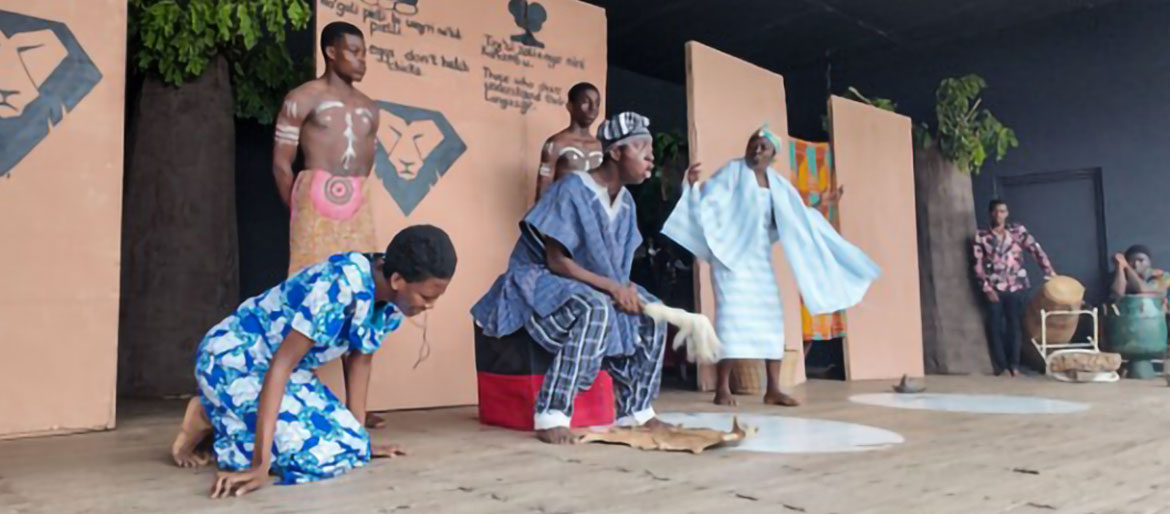
Senior high school students stage Verdict of the Cobra at the 2026 Greater Accra Student Drama Festival. Photograph source: 3News.
Student drama is the bridge between cultural education and the professional creative industries. A school production requires young people to interpret a text, research a social setting, speak clearly, control movement, design costumes and props, organise rehearsals, solve technical problems and work under a deadline. The result may be presented as entertainment, but the learning is wider: confidence, empathy, memory, discipline, collaboration, public speaking, planning and critical interpretation. For students who later enter film, broadcasting, education, tourism, law, public service or entrepreneurship, these are transferable skills.
Ghana’s 2026 Students Drama Festival, known as StuDraFest, provides a current national framework. The National Commission on Culture launched the senior high school competition in partnership with the National Theatre of Ghana, the Ghana Education Service and the Pan African Writers Association. Regional competitions have been used to select schools for the national stage, drawing the work of the regional Centres for National Culture into one process. The national finals were scheduled for 29 and 30 October 2026 in Accra. That timetable makes the festival a direct expression of the October Black Star Experience theme rather than a separate activity.
The Greater Accra Centre for National Culture has already demonstrated how a regional festival can connect education, heritage and recognised Ghanaian writing. In June 2026, participating senior high schools staged Verdict of the Cobra by Mohammed Ben Abdallah, a play that uses a marital dispute, twins, communal authority and the symbolic judgement of the Cobra to examine leadership, justice and decision-making. Students were required to do more than memorise lines. They had to interpret allegory, build believable relationships, manage stage space, coordinate costume and movement, and communicate a complex argument to an audience.
Such festivals should not be judged only by which school lifts a prize. The stronger measure is whether participation creates a learning pathway. Each regional programme should include short clinics in playwriting, acting, directing, voice, stage management, set and prop construction, costume, make-up, lighting, sound, documentation and basic screen adaptation. Teachers need preparatory materials and access to practitioners. Students who prefer technical roles should be recognised publicly, because the creative economy cannot grow if every participant is encouraged to seek visibility while production crafts remain understaffed.
Local-language performance deserves deliberate support. A school in Ho should be able to develop work in Ewe; a school in Tamale should be able to use Dagbani; schools in Accra should be able to stage Ga and Dangme material; and Akan, Dagaare, Gurene, Nzema, Gonja and other languages should be heard where they belong. Performances can include English summaries or surtitles so that national audiences can follow them without forcing the creative process into one language. This approach protects linguistic knowledge while training students in translation, subtitling and audience design, all of which are useful screen-industry skills.
The festival can also become a film-craft laboratory. Selected school plays could be adapted into five-to-ten-minute screen scenes under supervised conditions. Students could learn how a stage script changes when the camera selects a close-up, how location sound differs from projection in a theatre, how continuity is maintained across shots and why permissions are needed for music and recorded performance. UniMAC-IFT, the University of Ghana School of Performing Arts, the University of Education, Winneba, the National Theatre and practising guilds could support rotating clinics without removing ownership from the schools.
The national value of student drama lies in the pipeline it creates from classroom confidence to skilled creative work, while keeping Ghanaian language, literature and social questions present in the education of young people.
Safeguarding and inclusion must be built into the system. Schools and organisers should obtain consent for recording and publication, protect minors’ personal information, provide safe transport and rehearsal arrangements, and ensure that participation is open to girls, students with disabilities and young people whose strengths are technical rather than performative. Scripts should be discussed critically where they involve violence, gender, religion or ethnic representation. Cultural authenticity is not achieved by exposing students to harm or repeating stereotypes; it is achieved by informed interpretation and respectful practice.
A simple national record would make the programme more useful. Each region could document participating schools, student roles, languages used, scripts performed, workshops delivered, audience size and progression into later training. The record should follow students only with appropriate consent and privacy protections. Over time, the data would show whether drama festivals are reaching all regions, which crafts need more instruction and how many participants move into tertiary arts education, apprenticeships, community theatre, broadcasting or film. That evidence would justify investment more convincingly than ceremonial photographs alone.