
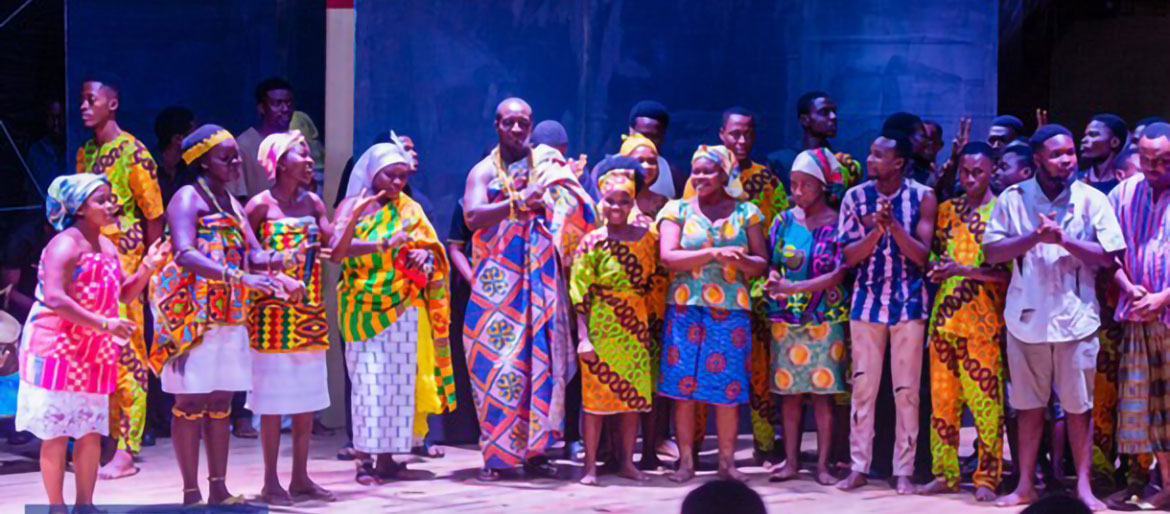
The cast of Anansegorndwom at the University of Education, Winneba, 2026. Photograph source: UEW Department of Music Education.
Oral tradition can generate contemporary work without being reduced to raw material that anyone may take without acknowledgement. The first responsibility is documentation with context. Researchers and creators should identify the community, language, narrator or custodian, performance setting, known variants and restrictions on use. Some narratives are widely shared and invite adaptation; others may be connected to ritual authority, family history or sacred knowledge. Consent, attribution and benefit are therefore not administrative details. They determine whether cultural development strengthens trust or turns heritage into extraction.
The work of Efua Sutherland offers an important model of transformation. Anansegoro did not merely copy a folktale onto a modern stage. It retained the Storyteller, song, audience awareness, moral ambiguity and the restless intelligence of Ananse while creating a theatrical structure suitable for contemporary performance. The Marriage of Anansewa demonstrates how a recognisable oral figure can be used to examine ambition, family negotiation, performance and social status in a changing society. The model encourages invention while keeping the relationship between form, community memory and present-day questions visible.
That relationship remains active. In March 2026, the University of Education, Winneba, staged Anansegorndwom, written by Professor Emmanuel Obed Acquah, as a musical drama combining narration, drumming, dance, recitative and four connected stories about Ananse. The production explored injustice, ambition, love, leadership, wisdom and greed while using contemporary academic and performance resources. It is a useful example of how a university can preserve indigenous knowledge by producing new work, training performers and documenting a living tradition rather than treating folklore as a static museum object.
The enterprise possibilities extend across media. One carefully researched story may generate a stage play, short film, animated series, illustrated book, podcast, radio drama, school resource, game, museum performance or visitor experience. Each form creates different work for writers, translators, performers, composers, designers, illustrators, animators, camera crews, editors, software developers, marketers and educators. The national-development question is not whether every folktale should be commercialised. It is how Ghana can build ethical pathways through which suitable narratives create income, education and cultural visibility while custodians and creators remain recognised participants.
Copyright is central to that pathway. Ghana’s Copyright Act, 2005, Act 690, protects literary, dramatic, musical and audiovisual works and contains provisions relating to folklore. Creators need practical knowledge of contracts, ownership, adaptation rights, performance rights, music clearance, credit and royalty collection. A writer who accepts a one-page agreement without understanding future streaming, television or international rights may lose the value of the work before an audience sees it. Cultural institutions, the Copyright Office, the Audiovisual Rights Society of Ghana, universities and professional bodies should therefore make rights education part of festivals, school programmes and production training.
Regional enterprise can grow around place-based narratives. A documented story connected to Cape Coast or Elmina may support a short film and guided heritage programme; a northern epic or praise tradition may support a performance, recording and language resource developed with its custodians; a Ga or Dangme narrative may be linked to an Accra or coastal cultural itinerary; a museum object in Kumasi may be interpreted through theatre; and an Ewe story may move between community narration, school performance and subtitled animation. These examples should be designed with local researchers, storytellers, educators and businesses so that cultural tourism does not detach a story from the people who give it meaning.
The creative value chain begins before the script and continues after the screening: research, consent, writing, contracting, production, marketing, exhibition, archiving, rights management and community benefit are all part of the work.
Digital distribution expands reach but also increases risk. A short video can introduce a Ghanaian story to diaspora audiences within hours, yet the same speed makes unattributed copying, distorted context and unauthorised monetisation easier. Producers should preserve original files and contracts, embed accurate metadata, use consistent credits and register works where appropriate. Platforms and broadcasters should commission in ways that leave Ghanaian creators with fair recognition and a meaningful share of long-term value. Subtitling in English, French and selected African languages can widen the market without displacing the original Ghanaian language track.
National institutions can make the market easier to enter. Small development grants can support research and script preparation before expensive production begins. Shared regional equipment, editing suites and rehearsal spaces can reduce start-up costs. Public broadcasters and digital platforms can commission short work from regional creators. Festivals can host rights clinics and markets. Tourism agencies can package screenings with heritage destinations. Most importantly, the Ghana Statistical Service and sector institutions should update the evidence base. The WIPO figures show that copyright industries already had measurable weight by 2016, but policy in 2026 requires current, disaggregated data on film, theatre, digital production, regional employment, audiences, revenue and exports.