
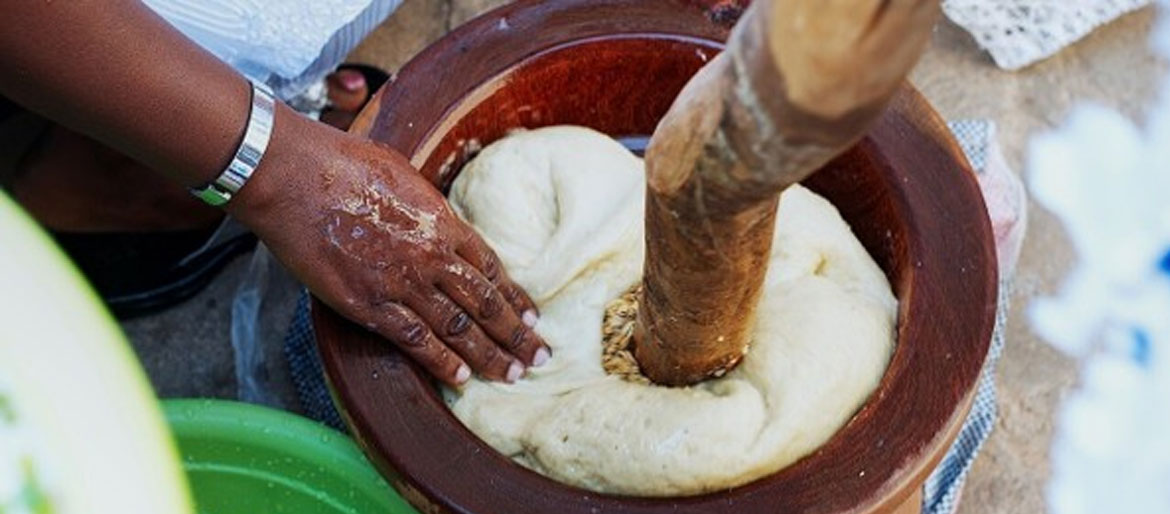
Traditional pounding of fufu, showing a food technique sustained through practical knowledge. Credit: Bright Kwame Ayisi (Kwameghana) / Wikimedia Commons, CC BY-SA 4.0.

Ghanaian cuisine is best understood as a collection of related food cultures rather than one uniform national recipe book. Climate, soil, water, migration, language, belief and occupation have shaped what communities grow, preserve, cook and serve. The cultural meaning of a dish therefore rests not only in its ingredients but also in who prepares it, when it is served, the local name by which it is known and the story attached to it.
Food landscapes and community knowledge
Along the coast, fishing and fish processing gave rise to meals in which fermented maize staples are paired with pepper, fresh fish, smoked fish or soups. Ga kenkey, commonly called komi, and Fante kenkey, often called dokono, both depend on fermented maize dough, yet their preparation, wrapping, texture and accompaniments differ. Treating them as one undifferentiated product would erase the practical knowledge through which Ga and Fante communities created distinct foods from a shared crop.
Within Akan Forest and transition areas, plantain, cassava, yam and cocoyam support foods such as fufu, ampesi, eto and mpotompoto, accompanied by palm-nut, groundnut, light, garden-egg and green-leaf soups or stews. Fufu itself has regional variations in the proportions and combinations pounded, and it has travelled widely enough to be prepared across Ghana. Its national popularity should not obscure the local preferences and ceremonial meanings that surround it.
In Ewe communities of the Volta Region, akple, prepared from maize dough and commonly eaten with okro soup known as fetri detsi, remains an important marker of food identity. Abolo, yam dishes and different vegetable and fish combinations also reflect the region’s agricultural and riverine environments. In the Asogli State, Te Za is a harvest and thanksgiving festival centred on new yam. The programme includes the hailing and feasting on new yam, while customary observances precede general consumption. This connects food directly to gratitude, spirituality, community renewal and tourism. [4]
Northern Ghana’s food cultures demonstrate the ingenuity required to live within savannah ecologies. Tuo zaafi, popularly shortened to TZ, is served with green-leaf soups such as ayoyo-based preparations in many households. Tubaani uses cowpea, while millet and sorghum support porridges and other foods valued for their suitability to the climate. Shea is not merely an export commodity; its butter has long served culinary and household purposes in communities where the tree grows. These food systems contain knowledge about seasonality, storage and resilience that has national relevance in a period of climate uncertainty.
These regional relationships can be expressed directly. In Ga coastal communities, komi or Ga kenkey, fish and pepper, banku and okro, and kpokpoi during Homowo connect fermentation and fishing with hospitality and the memory of harvest. In Fante and Central coastal communities, dokono or Fante kenkey, fish and pepper, and fante-fante fresh-fish stew reflect coastal trade, fishing and a distinct body of maize-processing knowledge. Among Nzema and other Western coastal communities, akyeke served with fish, pepper and related accompaniments preserves cassava-processing knowledge while expressing coastal exchange and community identity.
In Akan Forest and transition communities, foods such as fufu, ampesi, eto, mpotompoto and varied soups reflect root and plantain agriculture, skilled pounding, family life and ceremonial meals. In Ewe and Volta communities, akple with fetri detsi, abolo, yam dishes and the food traditions surrounding Asogli Te Za connect maize and yam cultivation to harvest thanksgiving and communal feasting.
Across northern savannah communities, tuo zaafi with green-leaf soup, tubaani, and foods prepared from millet and sorghum demonstrate the importance of climate-responsive grains, legumes, shea and preservation knowledge. These examples are illustrative rather than exhaustive because food names, spellings, recipes and accompaniments vary by language, locality and family. [1]
Food as ceremony, memory and moral education
Food is often the material through which Ghanaian communities remember survival. Homowo, celebrated by the Ga, is marked by the preparation and sprinkling of kpokpoi or kpekple, a maize-based food associated with the festival’s remembrance of hunger overcome and the return of abundance. The act links present households with ancestral experience and turn a meal into public history. [3] Similarly, yam and millet festivals in other traditional areas place agricultural renewal at the centre of community thanksgiving.
At names ceremonies, marriages, funerals, festivals and homecomings, the choice and quantity of food communicate respect and responsibility. Elders may be served first, guests are expected to be received, and relatives contribute money, labour or ingredients. Food is therefore part of the moral economy of the family: people demonstrate care not only by what they say but by whether they help to feed others during important transitions.
The knowledge involved is extensive. Fermentation requires judgement about time, temperature, texture and acidity. Smoking and drying fish demands control of moisture and heat. Pounding fufu depends on coordination and experience. Grinding spices, preparing soup bases, wrapping foods in leaves and preserving grains all contain practical science. These techniques have often been transmitted informally by mothers, grandmothers, fathers, cooks, fish processors, farmers and market women without being recognised as intellectual property or technical expertise.
Food Month should therefore support documentation that goes beyond listing dishes. A useful national culinary archive must record local-language names, pronunciation, ingredients, preparation stages, utensils, ecological origins, variations, occasions of use, associated songs or proverbs, and the consent of the knowledge holders. Video and audio records should accompany written recipes because important knowledge is carried in gesture, sound, texture and timing. Communities must be recognised as custodians, not treated merely as sources from which information is taken.