
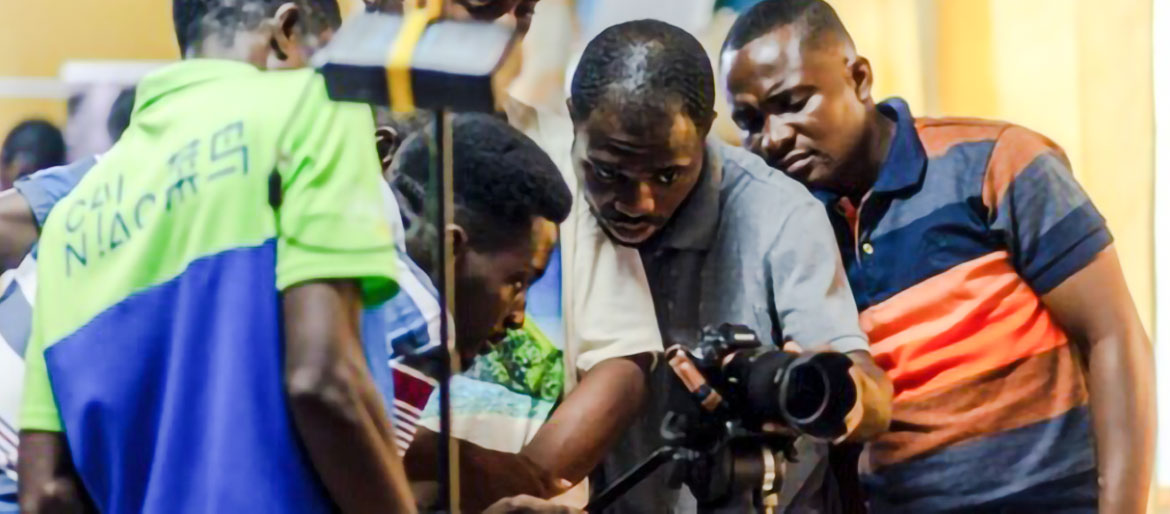
Hands-on youth documentary training in the Asuogyaman District. Photograph source: Africa Press Ghana, 2024.
Ghana does not lack stories. It lacks a sufficiently connected system for researching, developing, financing, producing, circulating and preserving them at consistent professional standards. The October theme shows how that system can be built. Oral tradition gives creators a deep narrative inheritance. Student drama gives young people a place to practise language, interpretation and collaboration. Film craft converts ideas into audiovisual work. Festivals and awards test quality, build audiences and create markets. Copyright, archives, training, finance and data turn isolated productions into an economy.
A national story and archive programme is the first foundation. The National Commission on Culture and its regional Centres should work with traditional authorities, community historians, universities, the Bureau of Ghana Languages, museums and archives to document selected oral histories, performance traditions, storytellers and scripts. Every record should include provenance, language, consent, access conditions and an agreed credit. The purpose would not be to place all knowledge online, but to prevent loss and create reliable research pathways for education and responsible adaptation.
A continuous education pathway should connect schools to professional craft. StuDraFest can become an annual national circuit with teacher preparation, regional workshops, technical categories and progression opportunities. Strong school productions can move into supervised screen adaptation, while students can be referred to tertiary programmes, apprenticeships, guilds and community companies. Evaluation should record participation by region, gender, disability, language and craft so that inclusion is measured rather than assumed.
Production support should reward cultural research and employment. Public grants, sponsorship and investment incentives can require a credible script-development process, transparent budgets, fair contracts, local crew development, safe working conditions and a distribution plan. Regional stories should have access to regional equipment and post-production support. Location filming should be connected to hospitality, transport, construction, tailoring, food services and visitor promotion, allowing expenditure to circulate through local economies.
Festivals and awards should operate as market and knowledge institutions. Ghana needs transparent judging, recognition of all film crafts, subtitling support, regional touring programmes, industry meetings and permanent archives. Award benefits should include development finance, equipment access, legal support, mentorship and distribution. Festival tourism can be strengthened through heritage visits, community performances and location tours that present Ghanaian culture with accuracy rather than as a decorative backdrop.
Rights protection and audience access must grow together. Creators require practical contract and copyright education, while audiences need convenient and lawful ways to watch Ghanaian work. Mobile cinema, school screenings, public television, licensed streaming, community venues and cinema investment are complementary routes. The National Film Authority’s classification and licensing framework should be implemented with clear guidance, and the Copyright Office and rights organisations should help creators document ownership and collect value from use.
Reliable data should guide every stage. Ghana should measure productions, employment, training, box office, streaming, festival attendance, exports, regional participation and the use of Ghanaian languages. The WIPO study showed copyright industries contributing 4.02 percent of GDP and an estimated 4.77 percent of national employment in 2016, but it also exposed the need for more detailed and current information. Regular public reporting would help government, investors and cultural institutions see which interventions create work and which merely create publicity.
The objective is not to move away from the fireside. It is to carry the knowledge, participation and moral seriousness of the fireside into classrooms, theatres, studios, festivals and screens that can reach Ghana and the world.
The Centre for National Culture, Greater Accra, can translate this agenda into visible public work through storytelling encounters, school drama support, heritage-based screenings, conversations on representation, oral-history documentation and partnerships with filmmakers and researchers. Its strongest contribution will come from linking national policy to communities and from using the Arts Centre as a place where the public can see, discuss and understand Ghanaian creative work. In collaboration with the regional Centres, this model can keep October nationally connected while allowing each region to present its own voices.
Ghanaian stories have already promoted the country through literature, theatre, television, film, festivals and the work of creators at home and in the diaspora. The next step is to organise that cultural strength into a durable development system. When the storyteller is credited, the student is trained, the crew is paid, the work is protected, the festival is trusted, the archive is preserved and the audience can gain access, culture performs its fullest national role. It preserves identity, develops citizens, creates livelihoods, attracts visitors and gives Ghana the authority to tell its own story.