
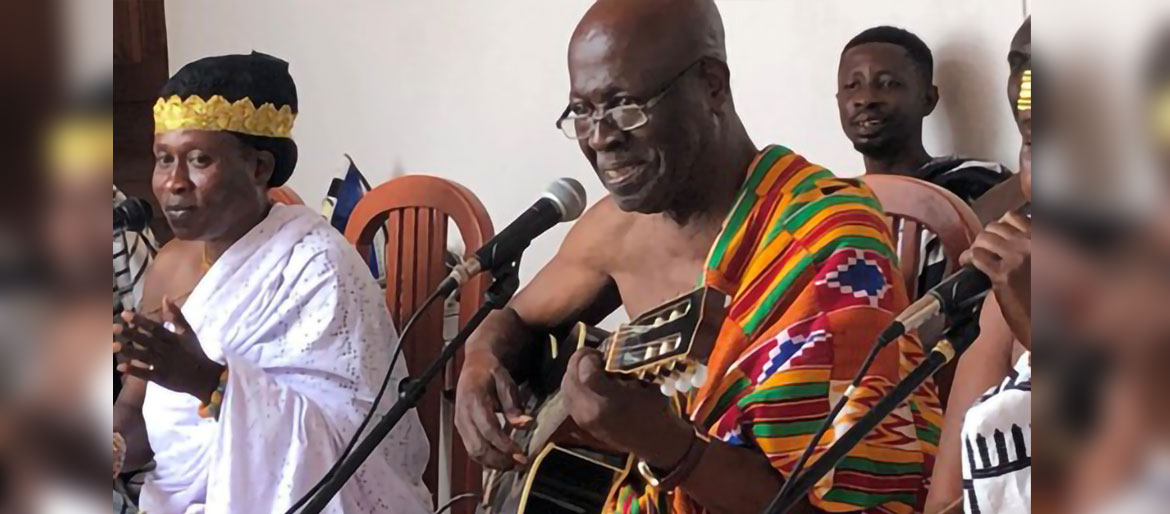
Story, song and performance transmit knowledge across generations. Photograph source: Witness Tree Institute of Ghana, 2022.
Long before a Ghanaian story reached a cinema screen, it lived in a voice, a gesture, a drum pattern, a proverb and the attentive response of an audience. In homes, palace courtyards, fishing communities, farm settlements and evening gatherings, narration was not simply a form of amusement. It taught children how to interpret conduct, warned adults against greed and abuse of authority, preserved memories of migration and conflict, and explained the obligations that held a community together. October’s Black Star Experience theme therefore brings film craft, festivals and awards, student drama festivals and storytelling into one cultural chain. Oral tradition supplies narrative memory; drama turns that memory into collective performance; film records, reshapes and circulates it; and festivals create occasions for public judgement, exchange and recognition.
Ghana’s storytelling traditions are diverse rather than uniform. Among Akan-speaking communities, anansesem centres on Kweku Ananse, the spider-trickster whose cleverness can expose vanity, selfishness, impatience and the misuse of power. The performance may combine narration, dialogue, song, call-and-response and audience commentary. The mboguo songs associated with the story interrupt the action, deepen its meaning and keep listeners actively involved. Ga, Dangme, Ewe, Guan, Gurma, Mole-Dagbani and other communities likewise preserve histories, moral instruction, praise, humour, riddles and proverbial wisdom in forms shaped by their own languages and social institutions. A responsible national celebration must name these differences, record the communities from which a story comes and resist presenting one tradition as the whole of Ghana.
Storytelling also belongs to Ghana’s modern institutional history. Efua Theodora Sutherland developed anansegoro as a contemporary theatrical form rooted in Ananse storytelling, with the Storyteller and song functioning as active elements in the drama. Her work in building the Ghana Drama Studio and her later association with the University of Ghana helped establish a space where indigenous performance could converse with modern playwriting, research and actor training. The University of Ghana’s Department of Theatre Arts, established in 1962, identifies Sutherland and Joe de Graft among the pioneers who shaped modern Ghanaian theatre by bringing indigenous performance traditions into contemporary forms. This is not a nostalgic footnote. It demonstrates that cultural inheritance becomes nationally productive when it is researched, taught, rehearsed, documented and reimagined.
The economic argument is equally important. The World Intellectual Property Organization’s 2020 study of Ghana, based mainly on 2013 to 2016 data, found that copyright-based industries increased their share of national gross domestic product from 3.07 percent in 2013 to 4.02 percent in 2016. The estimated number of people engaged in those industries rose from 262,736 to 452,759 over the same period. These figures cover a broad copyright economy, including publishing, broadcasting, music, theatre, film, software, visual art and supporting activities; they must not be misreported as film figures alone. They nevertheless show why stories, performances and audiovisual works deserve to be treated as productive assets as well as cultural expressions.
A story becomes a national resource when its cultural origin is respected, its creators and custodians are recognized, its rights are protected, and its adaptation creates learning, employment and value for the communities connected to it.
The continental opportunity is even larger. UNESCO’s 2021 mapping estimated that Africa’s film and audiovisual industries already employed about five million people and accounted for about US$5 billion in gross domestic product, while identifying a potential to create more than twenty million jobs and contribute US$20 billion to the continent’s combined GDP. These are Africa-wide estimates rather than Ghana-specific projections. For Ghana, their value lies in showing what can become possible when story development, skills, finance, copyright, exhibition, distribution and reliable data are treated as parts of one system.
This publication approaches October as a working month rather than a ceremonial label. It asks how Ghana can preserve the integrity of its stories while making room for invention; how school drama can become a pathway into professional film crafts; how festivals and awards can raise standards and attract visitors; how oral knowledge can move into theatre, animation, documentary, podcasting and screen production without being stripped of context; and how public institutions, schools, communities and private enterprises can share responsibility. The central position is simple: Ghana will gain more from its stories when culture is treated as knowledge, craft, intellectual property, public education and economic infrastructure at the same time.