
Literacy remains one of the most powerful tools for national transformation and sustainable development. It extends far beyond the basic ability to read and write simple texts. True literacy encompasses comprehension, interpretation, analytical reasoning, critical thinking, effective communication, and the capacity to engage responsibly in civic and economic life. It enables individuals to access information, evaluate ideas, make informed decisions, and participate meaningfully in national discourse.
In the modern knowledge economy, literacy functions as a gateway to opportunity. A literate population is better equipped to innovate, adopt new technologies, contribute to research and development, and respond effectively to social and economic challenges. Literacy strengthens democratic participation by empowering citizens to understand policies, engage constructively in governance processes, and hold institutions accountable. At the same time, it enhances social cohesion by enabling shared understanding and dialogue across diverse communities.
Beyond its developmental implications, literacy plays a critical cultural role. It ensures the preservation, documentation, and transmission of Ghana’s collective memory. Through literacy, traditions are recorded, languages are preserved, histories are documented, and cultural values are sustained across generations. Without literacy, heritage risks fragmentation; with literacy, heritage gains permanence and accessibility.
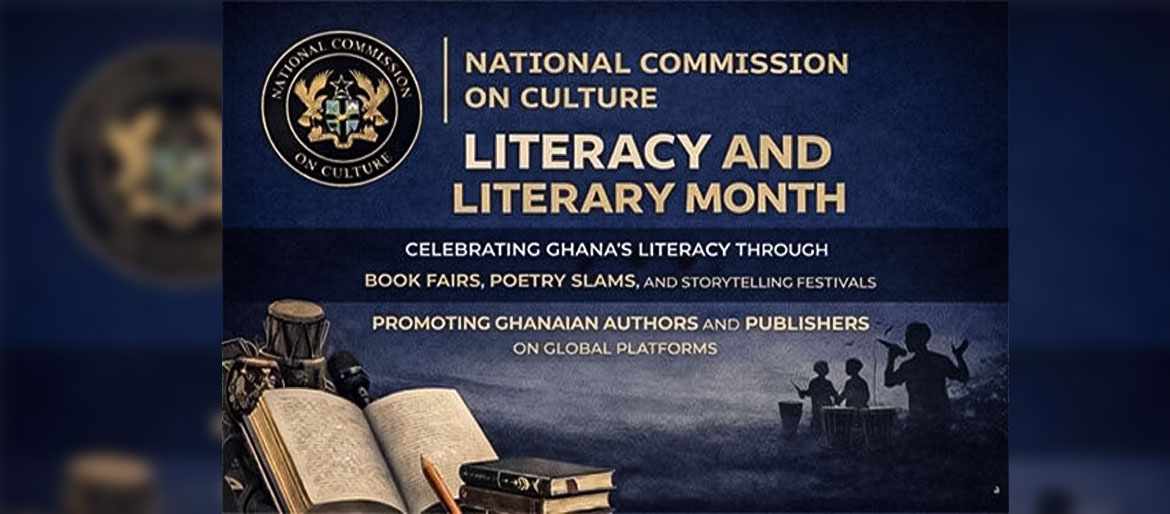
Recognizing this multidimensional importance, the National Commission on Culture, under the Black Star Experience, dedicates this month to Literacy and Literary Month as part of its statutory mandate to safeguard Ghana’s cultural heritage while promoting contemporary creativity and intellectual advancement. This observance aligns with national development priorities that emphasize education, creative industry growth, youth empowerment, and cultural diplomacy.
The thematic focus of Literacy and Literary Month acknowledges that literacy development and literary expression are mutually reinforcing pillars of national identity. Literacy provides citizens with the foundational skills necessary to engage knowledge systems, while literature transforms those skills into creative expression. Through literature, Ghana’s stories, philosophies, aspirations, and lived experiences are articulated, preserved, and shared with both local and global audiences.
Literature also fosters empathy, imagination, and reflection. By engaging with diverse narratives, readers develop broader perspectives and deeper cultural awareness. In this way, literary development strengthens not only intellectual capacity but also emotional intelligence and national consciousness.
Through structured programming, coordinated activities, and thematic guidance across all Centres for National Culture, Literacy and Literary Month serves as both a celebration and a strategic national intervention. It is a celebration of Ghana’s literary achievements and storytelling traditions, and at the same time, a call to action for sustained investment in reading culture, publishing, language preservation, and creative innovation.
By dedicating focused attention to literacy and literary development, the National Commission on Culture reinforces its commitment to building a culturally confident, intellectually empowered, and globally visible Ghana.