
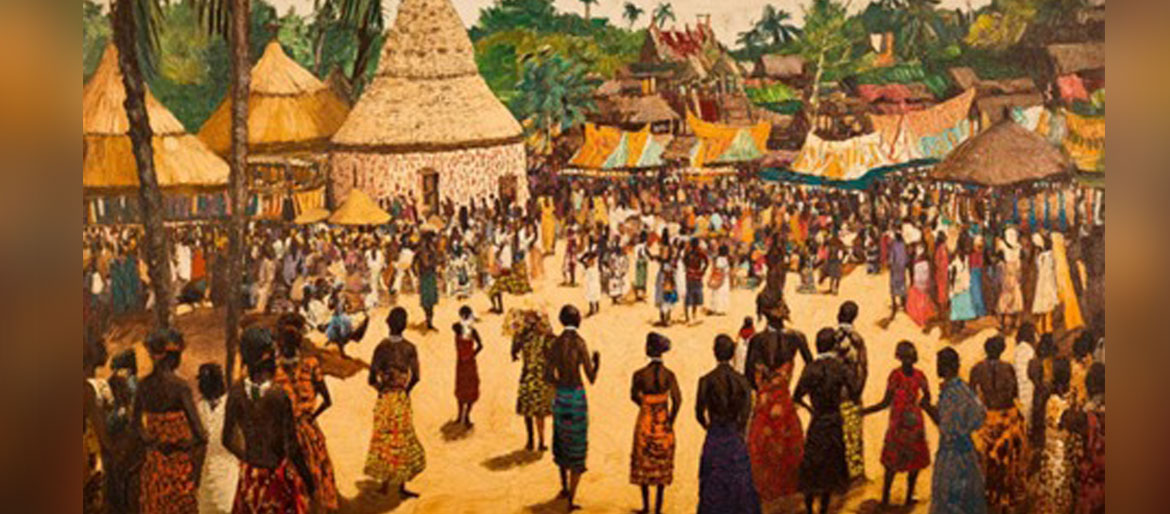
By the late 17th century, the Ashanti Empire emerged as one of the most powerful and organized states in West Africa, marking a major transformation in the political history of the forest belt. Its rise was not sudden, but the result of strategic unification, military innovation, and strong spiritual foundations that brought together previously independent Akan states.
The formation of the empire is closely associated with Osei Tutu I, whose leadership, in collaboration with the priest and statesman Okomfo Anokye, established a new system of centralized authority. Central to this unification was the symbolic and spiritual significance of the Golden Stool, believed to embody the soul of the Ashanti nation. This symbol served not only as a unifying force but also as a foundation for political legitimacy and collective identity.
Following its establishment around 1701, the Ashanti Empire expanded rapidly, incorporating surrounding Akan states and extending its influence across large parts of present-day Ghana. Kumasi, the capital, developed into a major political, economic, and cultural center, facilitating trade in gold, kola nuts, and other commodities. The empire’s well-structured governance system, supported by a hierarchy of chiefs and administrators, ensured stability and cohesion across its territories.
Militarily, Ashanti became a formidable force, capable of defending its interests and projecting power beyond its core regions. It engaged in strategic conflicts and alliances with neighboring states such as Denkyira, Akwamu, and others, while also interacting with European traders along the coast. Through these engagements, Ashanti positioned itself as a dominant intermediary in regional and international trade networks.
Beyond its political and economic strength, the Ashanti Empire made enduring contributions to culture and identity. Its traditions, including language, kente weaving, gold regalia, and systems of governance, have had a lasting influence not only within Ghana but across the African diaspora.
In the context of the Black Star Experience theme of History and Diaspora, the Ashanti legacy holds global significance. Elements of Ashanti culture and resistance have been preserved and reinterpreted among African descended communities in the Caribbean and the Americas. From naming traditions to artistic expression and historical memory, Ashanti identity continues to shape the cultural consciousness of the diaspora.
The story of the Ashanti Empire therefore represents more than the rise of a powerful state. It is a story of unity, resilience, and cultural continuity that connects Ghana to a wider global narrative of African heritage and influence.