
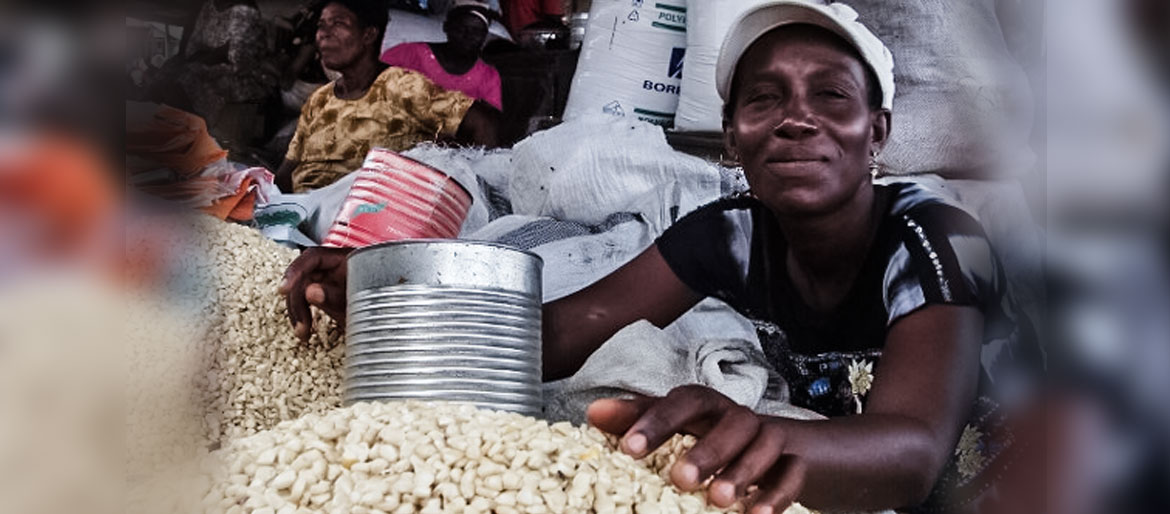
Florence Amoate sells maize from northern Ghana at Kokomba Market, Accra, connecting production with urban demand. Credit: Susan Quinn, USAID / Wikimedia Commons, public domain.
.jpg)
The national development value of food lies in the full chain that connects land and water to the final consumer. Cultural promotion can increase demand, but demand must be matched by reliable production, storage, processing, transport, safety, finance, packaging and market access. Ghana will gain more from Food Month when it treats cuisine not as an isolated creative activity but as the public face of an integrated agri-food economy.
Document of the national culinary heritage
Ghana needs a coordinated culinary-heritage inventory led by cultural and research institutions in partnership with communities, universities and local assemblies. Documentation should cover foods that are still widely prepared as well as endangered dishes, seed varieties, utensils, preservation techniques, markets and festival practices. The inventory should map knowledge holders and record regional variations instead of searching for one official recipe. Communities must give consent and receive recognition in any publication, exhibition or commercial use of their knowledge.
Build production and processing around Ghanaian demand
Cultural promotion can create dependable markets for farmers when hotels, restaurants, schools, hospitals, state institutions and events source more Ghanaian food. Procurement arrangements should aggregate demand and give producers clear quality and delivery requirements. Where a crop is seasonal, processing into flour, dried ingredients, frozen portions, sauces or other safe forms can extend availability and reduce waste.
Post-harvest losses of up to 30 per cent, reported by the Ministry of Food and Agriculture, represent lost farmer income, lost food and higher consumer prices. [10] Community warehouses, drying facilities, cold rooms, pack houses, refrigerated transport and small-scale processing centres are therefore cultural infrastructure as well as economic infrastructure. They preserve the ingredients without which traditional foods cannot survive.
Support women and young people across the value chain
Women have historically played central roles in food processing, market trade, catering and the transmission of recipes. Youth are increasingly active in delivery services, digital marketing, food photography, restaurant concepts, packaging, agritech and event production. Support should combine respect for older knowledge holders with opportunities for younger entrepreneurs. Training must cover costing, bookkeeping, food safety, customer care, branding, e-commerce, equipment uses and export readiness.
Apprenticeship can be strengthened through accredited community culinary programmes. Experienced traditional caterers, chop-bar operators, fish processors and food vendors should be invited to teach alongside professional chefs and food scientists. Certification should recognise practical mastery without forcing every local food into a hotel-style presentation. The goal is to raise safety and business standards while preserving taste, method and identity.
Create a trusted Ghana food brand
A national Ghana food mark could identify products and experiences that meet agreed standards of Ghanaian origin, safety, truthful labelling and cultural interpretation. It should not belong only to large companies. Cooperatives and small enterprises must be able to qualify through technical support and shared testing or packaging facilities. The mark could be used in restaurants, food festivals, airports, hotels, export shops and digital marketplaces.
Branding should emphasize provenance. A consumer should know whether a product is connected to a particular region, producer group or method. Distinctive foods and ingredients may also benefit from intellectual-property tools such as collective marks or geographical indications where the legal and commercial conditions are appropriate. Protection must serve community producers rather than merely creating new labels.
Link culture, tourism, trade and public health
Food policy is often divided among agriculture, trade, health, tourism, education, culture, local government and industry. The result can be strong individual programmes with weak coordination. A national culinary-economy working group could align cultural documentation, tourism promotion, food-safety enforcement, business support, export development and public procurement. Regional Coordinating Councils and Metropolitan, Municipal and District Assemblies would then adapt the framework to local crops, festivals, markets and tourism assets.
Development must also mean that Ghanaians can afford safe and nutritious food. The Ghana Statistical Service reported food insecurity at 38.1 per cent in the third quarter of 2025. [12] Food Month should therefore avoid presenting cuisine only as luxury restaurant culture. Local grains, legumes, vegetables, fruits and fish can support nutritious menus in schools and households when production, distribution and public education work together. Heritage and health should reinforce each other.
Measure what Food Month produces
A cultural programme becomes stronger when its results are recorded. Food Month activities should report the number and regional spread of participating enterprises, women and youth trained, vendor sales, new supply agreements, products certified, tourism bookings, recipes documented, apprentices placed, export enquiries generated and media reach achieved. Measurement should include community benefits and cultural accuracy, not only attendance.
The following national actions would convert celebration into a practical development programme:
The first action is to establish a Ghana Culinary Heritage Inventory supported by regional documentation teams and clear community-consent protocols. This national record should be matched by pilot culinary tourism routes in selected regions, linking living food traditions to festivals, markets, farms, fisheries, museums and craft centres so that cultural interpretation generates local opportunity.
The production system should then provide shared processing, cold-chain, testing and packaging facilities for small food enterprises and producer groups. A credible Ghana food quality and origin mark should connect safety and traceability with truthful cultural interpretation, while public institutions and hospitality businesses expand structured purchasing of safe Ghanaian produce and processed foods. Traditional food custodians, women-led businesses and youth entrepreneurs should receive practical training in food safety, finance, digital trade and export compliance.
Ghana’s missions abroad, diaspora organisations and tourism bodies should also coordinate regular culinary-diplomacy and market-development events. Their work should be assessed through an annual Food Month results report that records cultural documentation, economic participation, business growth and measurable community benefit.
These actions do not require Ghana to invent a new culture. They require the nation to organise, protect and add value to the knowledge and productive activity that already exists. The strongest food industry will be one in which the farmer, processor, cook, researcher, community and consumer can all see their place in the same national system.