
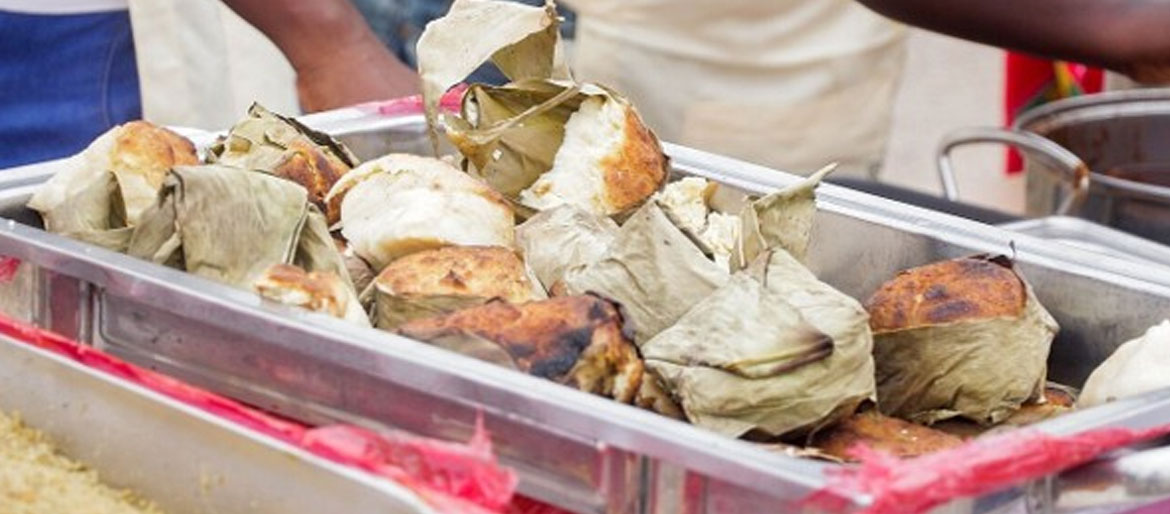
Prepared Ghanaian local food at a community event. Credit: Fquasie / Wikimedia Commons, CC BY-SA 4.0.

Food Month offers Ghana an opportunity to look beyond food as a daily necessity and recognise it as a cultural archive, a national brand and a productive economic system. Every Ghanaian dish carries several histories at once: the ecology that produced its ingredients, the community that refined its preparation, the family that transmitted the knowledge, the market networks that made it available, and the social occasion that gave it meaning. Food therefore belongs within any serious discussion of Ghanaian identity, tourism, trade, health, agriculture and national development.
The diversity of Ghanaian cuisine reflects the country’s varied landscapes and cultural communities. Fishing settlements along the coast developed food traditions around fresh, smoked, salted and dried fish. Forest communities drew on plantain, cocoyam, yam, cassava, mushrooms, palm fruit, leafy vegetables and game. Savannah communities built durable food systems around millet, sorghum, maize, rice, cowpea, groundnut, shea and drought-resistant vegetables. Through migration, intermarriage, trade, schooling and urban life, many of these dishes travelled far beyond their places of origin and became part of a shared national menu. [1]
Ghanaian food culture is also evidence of creative adaptation. Yam, millet, sorghum, oil palm and indigenous vegetables have deep histories in West African food systems. From the sixteenth century onward, crops from the Americas, including maize, cassava, tomato and groundnut, were gradually absorbed into local agriculture and transformed through Ghanaian knowledge. Kenkey, banku, akple, gari, fufu combinations and numerous soups and stews show that cultural authenticity does not mean refusing change. It means a community makes ingredients meaningful through its own methods, names, tastes, rituals and memories. [2][3]
The cultural value of food becomes visible at the most important moments of life. Meals welcome a child, confirm hospitality during marriage negotiations, sustain mourners at funerals, honour guests at festivals, reunite hometown associations and connect migrants to their places of origin. A visitor may first understand Ghana not through a formal lecture, but through the way a meal is presented, shared and explained. The Ghanaian table is therefore one of the country’s most accessible classrooms of culture.
Food is equally important to the economy. It links farmers, fishers, processors, transporters, market traders, caterers, chop-bar operators, restaurants, hotels, packaging companies, delivery services, exporters, event organizers and tourism businesses. The Ministry of Food and Agriculture reported in 2025 that agriculture contributed about 20 per cent of national GDP, employed roughly one-third of the workforce and supported the livelihoods of more than 70 per cent of rural households. The same official account warned of post-harvest losses of up to 30 per cent of output and a national food import bill exceeding US$3 billion. [10] These figures show both the scale of the opportunity and the cost of failing to develop it.
National evidence strengthens this case. The Ghana Statistical Service recorded 888,516 inbound overnight visitors between the fourth quarter of 2022 and the third quarter of 2023, with a median stay of 12 nights. Because food and beverages form part of visitor spending, stronger culinary experiences can retain more tourism income within local farms, markets, restaurants and communities. The Ministry of Food and Agriculture’s 2025 account, which placed agriculture at about 20 per cent of GDP and roughly one-third of national employment, further demonstrates that the promotion of cuisine is directly connected to farming and jobs. [5][10]
The same development agenda must confront food insecurity, which the Ghana Statistical Service reported at 38.1 per cent in the third quarter of 2025; cultural celebration must therefore remain connected to affordability, nutrition and access. Ghana’s non-traditional exports reached approximately US$5.007 billion in 2025 across all non-traditional export sectors, indicating room for agribusiness and value-added foods within a growing export system. These indicators come from different reporting periods and should not be combined as one estimate, but together they show why Food Month must connect heritage with livelihoods, public health and market development. [11][12]
The central argument of this publication is therefore straightforward: Ghanaian food is already promoting the country, but its cultural and economic value remains under-organised. Ghana can gain more from its cuisine by documenting regional knowledge, strengthening food tourism, supporting safe and export-ready businesses, connecting producers to hospitality markets, reducing post-harvest losses and presenting Ghanaian dishes consistently in national and international spaces. Food Month should be both a celebration of heritage and a call to build a more productive food economy.
Editorial principle: No single dish represents all Ghanaians, and several popular foods are shared across West Africa. The strongest national story is one that names local custodians accurately while showing how movement and exchange have created a wider Ghanaian food culture.